


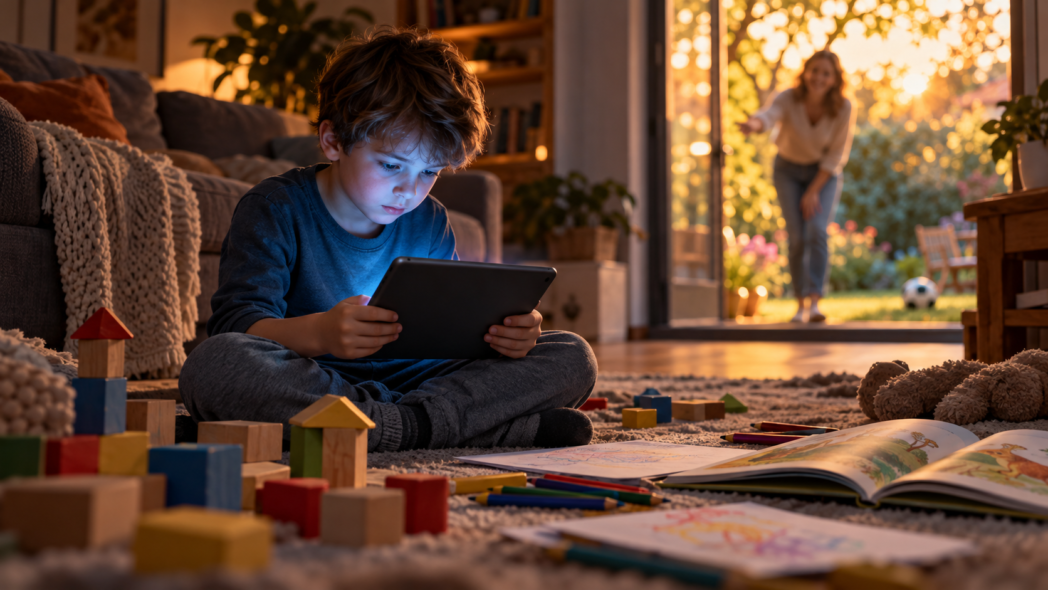
Your child can watch videos for an hour, yet struggles to stay with a puzzle for five minutes. Turning off the tablet leads to arguments. Suggestions to “go play” seem to go nowhere.
Does this mean screens have damaged your child’s attention span? Are educational apps different? And how can you reduce screen time without turning every afternoon into a battle?
Research offers useful answers, but they are more nuanced than alarming headlines suggest. Children’s digital experiences vary enormously. What they watch, how they use devices, who joins them, and what screen time replaces all matter.
The goal is to build a daily life in which technology leaves enough room for the experiences children need to learn, connect, and become increasingly independent.
How Does Screen Time Affect Children’s Brain Development?
A video call with a grandparent, a creative coding project, and an endless stream of short videos are different experiences. Counting them as identical minutes misses important differences.
The American Academy of Pediatrics’ 2026 guidance recognizes that well-designed digital experiences can support learning and well-being. It also warns that platforms built to maximize engagement can prolong use and displace healthy activities, including sleep and movement. American Academy of Pediatrics
Research also requires careful interpretation. Many studies find associations between heavier screen use and developmental difficulties. An association does not establish that screens caused the difficulty. Sleep, family stress, existing developmental differences, and the reasons a child uses a device can influence the relationship.
For example, a child who already struggles with self-regulation may seek screens more often—or receive them more frequently from exhausted caregivers.
Do Screens Change the Brain?
Brain-imaging research has raised important questions. In a small study of 47 preschoolers, pediatric researcher Dr. John Hutton and colleagues found associations between higher scores on a screen-use measure and differences in white matter pathways involved in language, executive function, and early literacy.
However, this was an observational study. It did not establish that screens caused brain injury, demonstrate permanent damage, or predict an individual child’s future. The researchers called for further investigation. JAMA Network
Parents should therefore be cautious with claims that screens “destroy brain cells” or permanently “rewire” every child’s brain. Those statements go beyond what this evidence can show.
A more useful question is: What experiences is my child getting plenty of—and what experiences are becoming scarce?
Screen Time, Attention, and Concentration
Parents often wonder why a child can concentrate on a game but struggle with homework.
These activities make different demands. A game may provide constant prompts, immediate feedback, and frequent rewards. Reading or solving a difficult problem requires the child to maintain a goal with less external encouragement.
Watching something intently is therefore not the same as independently managing attention.
The AAP identifies weaker attention control among the difficulties associated with problematic digital media use in school-age children. This does not mean every child who enjoys screens has an attention disorder. HealthyChildren.org
A practical first step is to reduce competing stimulation:
- Turn off background television during play and conversation.
- Keep entertainment videos away from homework.
- Silence unnecessary notifications.
- Give activities a clear beginning and a manageable goal.
Observe when concentration becomes difficult. Does your child struggle after a poor night’s sleep? Only with reading? Across both home and school? That pattern is more informative than screen time alone.
What About Memory, Planning, and Higher Thinking Skills?
Children use executive functions to manage their thoughts and behavior. These include:
| Skill | What it helps a child do |
|---|---|
| Working memory | Remember instructions while carrying them out |
| Inhibitory control | Pause before acting and resist distractions |
| Cognitive flexibility | Change strategies when something does not work |
Together, these abilities support planning, problem-solving, learning, and increasingly independent decisions.
Harvard University’s Center on the Developing Child explains that executive function and self-regulation develop through interactions and practice. Its activity guides recommend age-appropriate games and experiences that give children opportunities to use these skills. developingchild.harvard.edu
This helps explain an important concern about excessive recreational screen use: the practice it may replace.
Following a recipe requires remembering steps. Building a bridge requires planning and revision. Playing a board game requires holding rules in mind and waiting for a turn.
Some digital activities also involve these processes. The distinction is whether a child is actively thinking and making decisions, and whether digital activities leave room for other kinds of learning.
It would be misleading to claim that ordinary screen use inevitably damages memory—or that a particular worksheet can reverse its effects. Instead, give children varied opportunities to remember, explain, plan, and solve problems in daily life.
Emotional Regulation, Confidence, and Personality Development
Screens can provide welcome relief during a difficult moment. The concern arises when they become a child’s main way of handling frustration, waiting, or disappointment.
In a longitudinal study led by researcher Dr. Caroline Fitzpatrick, greater tablet use at age 3½ was associated with more anger and frustration at age 4½. Greater anger and frustration at age 4½ then predicted more tablet use at age 5½.
The findings suggest a possible two-way cycle, rather than a simple explanation in which devices alone cause challenging behavior. jamanetwork.com
Children also need support practicing other responses: asking for help, taking a break, tolerating a small disappointment, and trying again.
These experiences matter for growing independence. A child who completes a small real-world challenge has something concrete to recognize: “I figured that out.”
Screens do not determine a child’s personality. Relationships, temperament, opportunities, and many other experiences contribute to development. The aim is to preserve everyday opportunities for initiative, cooperation, persistence, and connection.
Why Sleep Deserves Special Attention
When reviewing screen habits, bedtime is a useful place to start.
The AAP recommends turning screens off at least one hour before bed and keeping devices out of children’s bedrooms, particularly overnight. healthychildren.org
Try replacing the final stretch of evening entertainment with a predictable sequence: wash, pajamas, prepare for tomorrow, then a story or quiet activity.
If your child currently falls asleep watching videos, change the routine with support. Sit together with a book, offer an audio story with the display off, or introduce another calming ritual. Expect the new routine to need repetition.
How Much Screen Time Is Too Much?
There is no single number that guarantees healthy development for every child.
The AAP’s 2026 policy emphasizes content and protecting healthy activities. When families want numerical guidance, it suggests discussing limits that fit their circumstances: examples range from less than one hour daily for toddlers and preschoolers to around one to two hours or more of entertainment media for school-age children and teens. These are discussion ranges, not developmental targets or guarantees of safety. publications.aap.org
For your family, ask:
- Is screen use pushing bedtime later?
- Does your child still move, play, read, and connect with others?
- Can devices be put aside for meals and responsibilities?
- Is the content appropriate?
- Is using or stopping screens causing persistent difficulties?
The AAP’s 5 Cs offer a helpful framework: the child, the content, using media to calm, what it is crowding out, and family communication.
The Best Screen-Free Activities Start With Your Child’s Needs
“Go do something else” leaves a child with two tasks: stop an appealing activity and invent a replacement.
Make the replacement more concrete. First, consider what the screen is providing.
The following suggestions are practical applications of that approach, rather than a clinically tested screen-reduction program.
| What your child may be seeking | A screen-free alternative | An invitation to try |
|---|---|---|
| Rest after school | An audio story and drawing materials | “You can listen and draw whatever comes to mind.” |
| Challenge and progress | A puzzle or building mission | “Can you build a bridge that holds three toy cars?” |
| Connection | A short shared game or cooking task | “I’d like your help inventing today’s snack.” |
| Adventure | An indoor or outdoor scavenger hunt | “Find something rough, something curved, and something that moves.” |
| Control and choice | A child-led project | “Would you rather design a shop or make a comic?” |
| Something to do while waiting | A small travel activity pouch | “Choose the picture hunt or the drawing challenge.” |
If the child is exhausted, a difficult worksheet may be a poor substitute. If they want company, a shelf of independent activities may not meet the need.
Everyday Activities That Give Thinking Skills Practice
You do not need expensive equipment.
For working memory: Put a few familiar objects on a tray. Let your child look, cover the tray, and ask what they remember. Adjust the number of objects to keep success possible.
For self-control: Try freeze dance or a stop-and-go game. Begin with simple rules before adding a change.
For flexible thinking: Ask for several ways to use a cardboard box, or change one rule in a familiar sorting game.
For planning: Invite your child to prepare a pretend picnic, organize a small treasure hunt, or build something from a quick sketch.
For reasoning: Ask, “What makes you think that?” during a story or puzzle. Leave room for an explanation before offering your own.
Harvard’s executive function guides include games and play-based practice across age groups. These activities offer opportunities to practice specific skills; they should not be presented as guaranteed ways to raise intelligence or treat attention difficulties. developingchild.harvard.edu
How to Help Children Enjoy Alternatives to Screens
An alternative becomes more appealing when a child feels interested, capable, and involved.
Harvard’s guidance on motivation recommends encouraging curiosity, offering meaningful choices, matching challenges to children’s abilities, and recognizing effort and strategies. developingchild.harvard.edu
Here is how that can look at home.
1. Prepare the First Step
Set out a few blocks and a toy animal rather than saying, “Play with your toys.”
Offer a small challenge: “This animal needs somewhere to hide.”
The activity is ready, and the child can see how to begin.
2. Offer Two Real Choices
“Would you like to make a maze or build an obstacle course?”
The boundary can stay clear while the child has a say in what happens next.
3. Join Briefly, Then Step Back
Start the first puzzle section together. Take the first role in pretend play. Once your child is involved, give them space to continue.
Independent play can begin with connection.
4. Keep the Difficulty Adjustable
If a task repeatedly ends in frustration, simplify it. If your child finishes immediately, add one new challenge.
The aim is an achievable stretch, rather than a test of patience.
5. Notice the Strategy
Try: “You made the base wider when the tower fell.”
This identifies a useful action your child can repeat.
6. Let Interests Become a Bridge
A child who loves a dinosaur video might enjoy making a fossil dig. A child fascinated by a building game might like designing a cardboard town.
You can also turn selected media into a starting point: watch a short demonstration together, then close the device and try it.
A 2024 review of 100 studies found that screen-use context mattered. Background television and greater program viewing were associated with poorer cognitive outcomes in young children, while shared media use was associated with better cognitive outcomes. Much of the evidence was observational, so these findings require cautious interpretation.
How to Reduce Screen Time Without Constant Arguments
Begin with one predictable change.
Observe the routine. For a few days, notice when devices appear, what they help with, and when stopping becomes difficult.
Choose one boundary. For example, make dinner screen-free or end entertainment before the bedtime routine.
Prepare the replacement. Have the activity available before screen time ends.
Explain the stopping point in advance. “We’re watching this episode, then we’re putting the tablet away.”
Acknowledge disappointment and keep the boundary.
“You wanted another episode. Stopping is hard. We’re finished for now. Would you like me to sit with you or help start your drawing?”
Review what actually improved. Look for easier evenings, more shared play, or fewer interrupted tasks. If the change creates a new problem, adjust the plan.
Turning off autoplay and unnecessary notifications can also make boundaries easier to maintain. The AAP recommends these steps as part of a family media plan. healthychildren.org
Frequently Asked Questions
Can screen time cause ADHD?
An association between screen use and attention difficulties does not establish that screens cause ADHD. Persistent difficulties deserve a broader assessment, rather than assuming that removing a device will explain or resolve them.
Why does my child become upset when screen time ends?
They may be disappointed, tired, absorbed in an unfinished activity, or struggling with transitions. A difficult reaction alone does not establish addiction. Notice its frequency, intensity, and effect on daily life.
Are educational apps better than entertainment videos?
Some can support specific learning goals. Look at what the child is actually doing: explaining, solving, creating, and applying something afterward—or mostly tapping for rewards. “Educational” is a label to examine, not a guarantee.
Are printable activities a good alternative?
They can be, especially when they match the child’s interests and ability. Picture searches, drawing prompts, and puzzles can provide focused activities. They work best as part of a varied day that also includes movement, conversation, and open-ended play.
What if my child says everything else is boring?
Offer a small starting point and some company. Boredom does not automatically lead to creative play, and children may need help getting started. Avoid filling every moment with instruction or expecting an immediate transformation.
How quickly will concentration improve?
There is no reliable “brain reset” timetable. Observe changes over time, and consider sleep, task difficulty, stress, and developmental needs alongside screen habits.
When should I seek professional help?
Speak with your child’s pediatrician if sleep, attention, mood, or screen-related conflict persistently interferes with school, relationships, or daily routines. Seek support for any loss of previously acquired skills. Screen limits can form part of a plan, but they should not replace an assessment when one is needed.
A Useful Place to Begin Today
Choose one moment when screens regularly take over. Decide what your child needs at that moment, prepare one appealing alternative, and introduce a clear routine.
A shared story, a building challenge, a conversation, or a small responsibility gives your child an opportunity to participate actively in life. Repeated, manageable opportunities are a practical foundation for healthier digital habits.